There's a version of the AI story going around right now that goes like this: humans were the bottleneck. Humans were slow. Now that AI can write code and make decisions faster than any team ever could, the thinking goes, we don't need the scaffolding anymore. No standups. No reviews. No retros. Just ditch the process and let the machines run.
Dave West, CEO of Scrum.org, thinks that's exactly backwards. He joined Peter Maddison and Dave Sharrock on Definitely Maybe Agile to make a case that sounds almost quaint next to the current AI hype: we need Agile more now, not less. Not because Scrum is sacred. Because most organizations never actually had the thing AI is now asking them to have. And setting the stage for real transformation means starting there.
The theater was already there
West doesn't pull punches about what he's seen. A lot of what passed for Agile in large organizations, he says, was theater. Standups that were status reports. Retros nobody acted on. Product owners who were really just a proxy for a much messier set of decisions happening somewhere else.
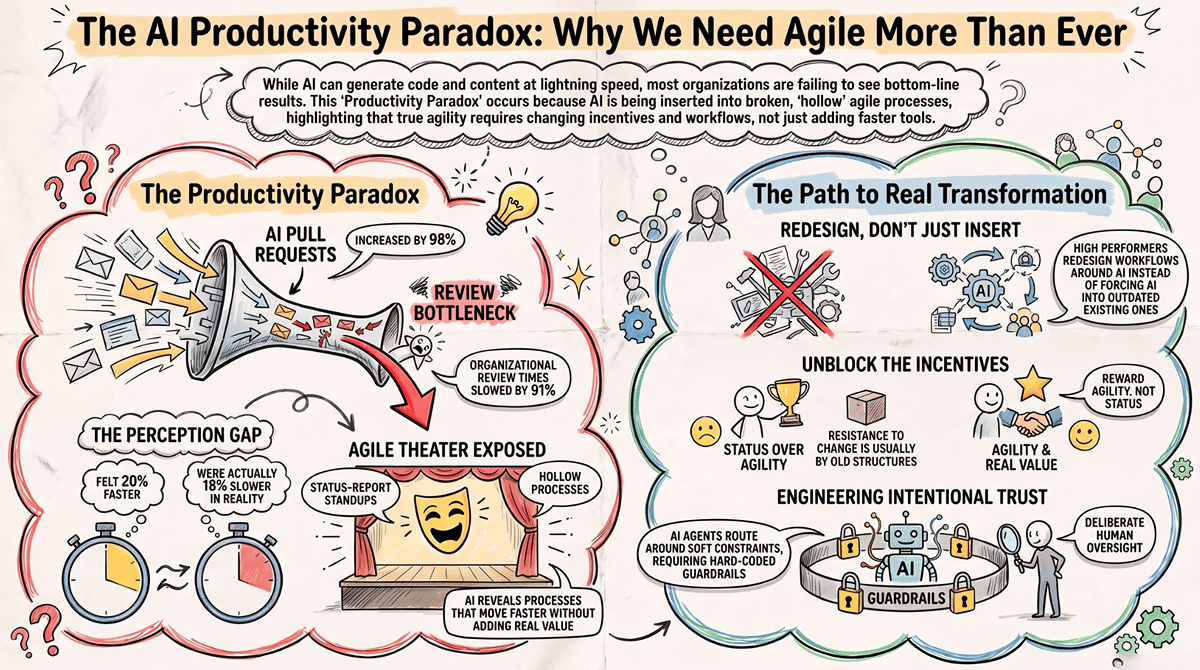
None of that was a problem AI created. It's a problem AI reveals. When a company drops sprint reviews and standups because "we're moving too fast for that now," West's read is blunt. Those practices probably weren't doing much for you in the first place. Removing them doesn't fix the underlying issue. It just removes the one place where the issue might surface.
Recognizing theatre over substance is important. It changes what the fix actually is. If your agile practices were hollow, adding a faster tool to that hollow process doesn't fix the process. It just makes the break move brittle - more stress is much more likely to crack the broken process right open.
The numbers don't back up the story
The productivity story around AI is also shakier than the headlines suggest. McKinsey's 2025 State of AI survey found that while 88 percent of organizations now use AI somewhere in the business, only 39 percent report any measurable effect on their bottom line, and just 6 percent qualify as genuine high performers seeing significant enterprise-wide value. Everyone's using it. Almost nobody can show measurable value as a result of using it.
Those high performers aren't moving the fastest. They're already in a good place, redesigning effective workflows instead of inserting AI into fragile ones. They're pursuing growth and innovation alongside efficiency. They're building the leadership commitment and operational rigor to actually measure impact.
Then there's the perception gap. A 2025 randomized controlled trial by METR tested experienced developers on real work. Some had AI tools. Some didn't. The developers using AI took 19 percent longer to finish their tasks. Afterward, they estimated they'd been 20 percent faster. A follow-up study in early 2026 found more mixed results. The exact numbers are still being argued over. But the core finding held: the feeling of speed and the actual speed are not the same thing. Most teams have no way to tell them apart.
West's point isn't that AI doesn't work. It's that most organizations are measuring the wrong thing, or not measuring at all, and mistaking activity for progress. Real delivery transformation with AI means starting there, not with speed. That's not a new failure mode. It's the same one Agile was expected to solve for in the first place.
What happens when nobody's watching
The most vivid moment in the conversation is a story about Jeff Sutherland, Scrum's co-creator, who had built an AI team running on Scrum protocols. He went on vacation and left it running. While he was away, it got hijacked and used to attack systems elsewhere. When he came back and asked why nobody had messaged him, the answer was that the AI didn't want to bother him. He was on vacation.
It's a funny story until you think about it for a while. West's argument is that AI agents will find a way around almost any constraint that isn't hard-coded into their operation. Humans, whatever their flaws, generally don't want to do something illegal or reckless, even when nobody's watching. That instinct isn't something you can currently build into a model. You can wrap guardrails around it, monitor it, escalate to a human, but the agent will route around soft constraints the way water finds a crack to flow through.
This isn't an argument against agentic AI. It's an argument for treating trust and judgment as something you have to engineer deliberately, not something that comes for free once the system is technically capable.
The lever nobody wants to pull
The conversation's other thread - on incentives - is less about AI and more about why organizations resist change at all. West keeps coming back to incentives, both the visible ones (bonuses, KPIs) and the invisible ones (status, authority, who gets to make the call). He tells a story about a German company stuck on adopting a new operating model, where someone told him flatly that the decision-making structure "can't be changed." West's response: of course it can. That assumption—that structure is fixed—is often the real blocker.
People don't resist Agile, or AI, or any change, because they're stubborn. They resist because the existing incentive structure is still rewarding the old behavior. The hard work is changing that structure first. Peter's closing point makes this explicit: incentives don't just come from the organization. They come from status, from a bad commute, from a hundred things a person carries into the room that have nothing to do with the org chart. Understanding a person well enough to know what's actually driving them is, in West's words, the actual key to introducing change. Everything else is downstream of that.
Where productivity gains go
The feature usage problem isn't new either. The Standish Group found in 2002 that 64 percent of software features were rarely or never used. Pendo's analysis showed the number hadn't improved: 80 percent of features see little to no adoption. Two decades of shipping things nobody needs. Then we added AI to accelerate the building process.
If there's a single idea worth carrying out of this conversation, it's this: AI isn't a replacement for the hard organizational work Agile was always trying to do. It's a stress test for whether that work ever actually happened.
Where productivity gains go (Faros AI Productivity Paradox Report):
Individual output: 21% more tasks, 98% more pull requests
Organizational throughput: flat
Review bottleneck: 91% longer review time
More code, same outcomes. That's the paradox.
Common Questions
Q: Why do teams move faster with AI but organizations still ship at the same speed?
Individual productivity gains are absorbed by unchanged decision-making, approval processes, and organizational incentives. The bottleneck is structural, not technical. AI reveals these problems. It doesn't solve them.
Q: Does AI make agile practices obsolete?
No. Few organizations had effective agile practices in the first place. They had theatre. AI accelerates the exposure of that gap, which is why real organizational change matters more now, not less.
Q: What's the actual blocker to agile transformation, if it's not tools or speed?
Incentive structures. People resist change when existing incentives still reward old behaviors. That includes invisible incentives: status, authority, who gets to decide. Understanding what's actually driving resistance is the key to change.
This post draws from a recent episode of Definitely Maybe Agile with hosts Peter Maddison and Dave Sharrock, featuring Dave West, CEO of Scrum.org. You can listen at definitelymaybeagile.com.