
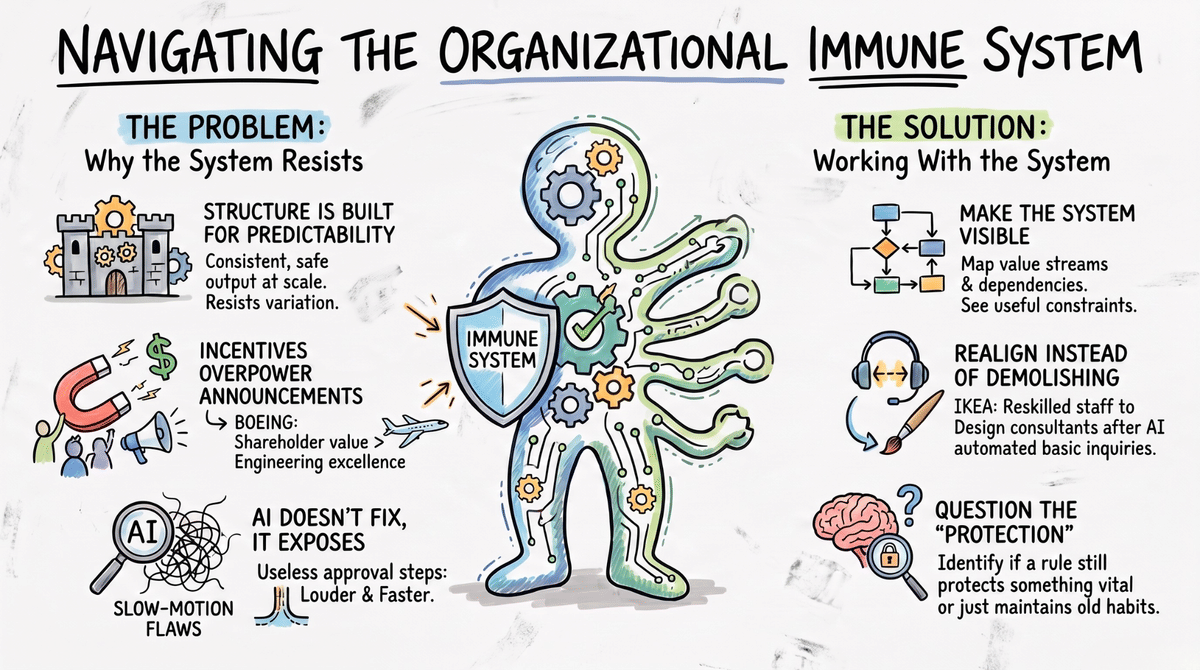
Resistance to change is the thing most leaders get wrong. They treat it as a people problem. It is not.
A client asked me last week why change felt so much harder in his organization than it did for him personally. He's a guy who has switched careers twice, moved cities, taken up ultra running in his forties. Individually, he adapts fine. Put him inside a 2,000-person company trying to shift how it works, and suddenly everything grinds to a halt.
That neatly frames the problem: people are wired for change, institutions are wired for stability.
Most people are actually good at change. What gets in the way isn't the people, it's the system they're standing inside. And if you're leading a transformation right now, understanding that difference will save you a lot of wasted effort.
The System Was Built To Resist You
Every rigid process in your organization exists for a reason. Somebody built it on purpose.
The approval chains, the reporting structures, the rule that says you can't charge time to a conversation unless there's a project code for it, none of that showed up by accident. It got built to make the organization predictable. Repeatable. Safe to run at scale. Easier to lead.
That's actually the point of an organization. You want consistency. You want the same output from the same input, most of the time. So you build culture and structure to guarantee it. And culture and structure, by design, resists variation. Including the variation you're trying to introduce when you push for change.
Most change efforts treat culture and structure as the enemy. Rip out the approval chain, flatten the hierarchy, kill the meeting cadence, and agility will follow. Except it rarely works that way. Remove a constraint without understanding what it was holding in place, and you don't get agility. You get a gap where something used to be, and no plan for what fills it. We've seen the same pattern with lost focus in large organizations: the layers of approval and process that people complain about are usually compensating for something real, and removing them without understanding what that is just creates a different kind of chaos.
The move isn't demolition. It's figuring out what the structure is protecting, and then deciding, on purpose, whether that thing still needs protecting the way it used to.
What Happens When The Culture Changes
Want to see what this looks like at scale? Look at Boeing.
Before its 1997 merger with McDonnell Douglas, Boeing ran on an engineering-first culture. Engineers had real influence over decisions. Risk-averse design and methodical testing came before the schedule. Then the merger happened, and McDonnell Douglas executives, known for prioritizing cost and shareholder value over engineering, moved into senior leadership. The center of gravity shifted from the people who understood the aircraft to the people who understood the spreadsheet.
Nobody woke up one morning and decided to sacrifice quality. It happened decision by decision, each one reasonable on its own, each one optimizing for what leadership was now being measured on. Redundancy that engineers had built in for safety started looking like waste on a balance sheet. Fortune's reporting on the 737 MAX crisis draws a direct line from that cultural shift, and the shareholder-first mindset it introduced, to the engineering compromises that followed.
Culture doesn't erode because someone decides to break it. It erodes because the incentives quietly stop protecting it. And once it's gone, you don't get it back with a memo. You get it back the same way trust gets rebuilt: slowly, and only through consistent behavior over a long stretch of time.
If you're changing how your organization works, look hard at what you're rewarding, not just what you're announcing. Look at the behaviours you encourage and reward, and those that lead to more work and negative recognition. We all naturally adjust our behaviour to these implicit and explicit incentives.
AI Doesn't Fix A Broken System, It Exposes One
Here's where it gets real for a lot of organizations right now.
The pattern I keep seeing: leadership brings in AI, points it at the existing process, and expects the process to magically get better. It doesn't. Nothing structural changes, because nothing structural was addressed.
What AI actually does is faster and less forgiving. It surfaces every problem you've been avoiding. The person who got promoted into a role they were never right for. The approval step nobody can explain the purpose of anymore. The conversation about performance that's been quietly deferred for two years because nobody wanted to have it.
Those used to be slow-motion problems. You could put them off, because the pace of change in most organizations was human pace. Weeks, months, a whole planning cycle before anyone noticed. AI collapses that timeline to days. The tough conversations you've been avoiding don't get easier, they just get louder, faster, and end up in your calendar next week, not at the end of the year.
This shifts the focus from the technology to the people.
Work With The System, Not Against It
Now that you know why things are the way they are, what can you do?
Start by making the system visible. Most leaders do not have a clear picture of their value streams. They sense them, but they have not mapped them. Frameworks like flow engineering give you a concrete way to do this. It walks through outcome, value stream, dependency, and capability mapping. Once you can see where the dependencies sit and where the friction lives, you can tell which constraints still do useful work. Then you choose, on purpose, what to loosen and what to leave alone.
IKEA is a good example of getting this right. When their AI assistant Billie started resolving roughly 47% of customer service inquiries, the obvious move was to cut headcount. Instead, IKEA looked at the 53% of inquiries Billie couldn't handle. Those unresolved conversations were mostly people asking for help with interior design, a need nobody had built a service around. IKEA reskilled the affected call center employees into design consultants instead of letting them go, and that new channel generated roughly €1.3 billion in revenue in its first year.
That's the difference between fighting your immune system and working with it. IKEA didn't tear down the customer service function. They found where the constraint had already loosened on its own, and pointed people at the opportunity that opened up.
Your organization's resistance to change isn't malfunctioning. It's doing exactly what it was built to do. The job isn't to defeat it. It's to understand it well enough to know which parts still deserve the protection they're getting, and which parts are just protecting habits nobody has questioned in years.
That's a harder conversation than "let's move fast and break things." It's also the one that actually works.
This post draws from a recent episode of Definitely Maybe Agile with hosts Peter Maddison and Dave Sharrock. Listen to the full episode at definitelymaybeagile.com.