
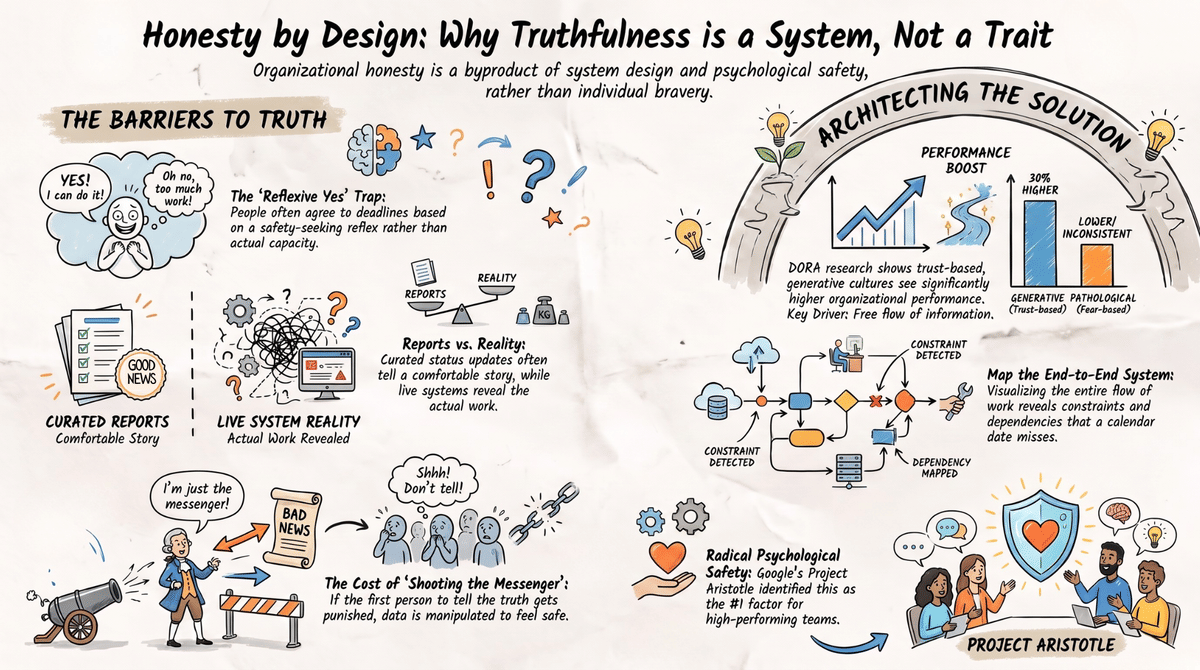
Honesty Isn't a Personality Trait. It's a System.
Why do teams hide bad news? It's rarely about dishonesty. Someone asks how a deadline is tracking. Maybe it's a release date. Maybe it's a new client who needs everything ready by the end of September. Either way, the honest answer takes real thought. What usually comes out instead is a reflex: "Yeah, I think we can do that."
I got into this with Dave on a recent episode. The gap between the reflex answer and the true one. The more we talked, the more it became clear this isn't really about honesty as some kind of personal virtue. It's about whether the organization gives people any room to be honest in the first place. Ask someone "are we on track for July 31?" and the answer depends a lot less on the actual state of the project than on how safe it feels to say no.
The eternal optimist problem
Dave admitted something I think most of us recognize in ourselves. He called himself an eternal optimist. Ask him if a deadline will hold and his gut reaction is to say yes. Not because he's lying to anyone. It's just the easiest answer to give in the moment, and honestly, most of us do the same thing without even noticing.
Here's the catch though. Two people can both say "yes, we can do that" and mean completely different things by done. Nobody actually checked. That mismatch doesn't show up until much later, right when there's no time left to fix it. It reminded me of something we talked about in an earlier episode on safe bets, that the comfort of saying yes quickly feels a lot safer than sitting with "I actually don't know yet," even when the second answer is the more honest one.
A real answer needs more than a yes or no. It needs some actual grounding. Have we done something like this before? Is this new territory for the team? Do we even know our own capacity right now? Those are the questions that rarely get asked before "yes" leaves the room.
A report is not the same as information
This is where the conversation got specific, and it's the part I keep coming back to. There's a real difference between preparing a status report and actually looking at what's happening in the systems where the work lives. One is a story about the work. The other is the work.
The bar for good visual management should be that it's cheap to produce. Not polished. Not something someone spent an hour dressing up with commentary and color coding. Just pulled straight from whatever near real-time system the team already works in. The moment someone has to spend real effort curating a dashboard before a meeting, you've already drifted from what's true into what's comfortable to present. We wrote about a version of this in Measuring What Matters, where a CEO told us his dashboard was green while his customers were still unhappy. Same trap, different meeting.
A hand-built status update tells you what someone decided to show you. A live board tells you what's actually going on. If your organization trusts people to just pull up the real system in the room and talk about what's on it, you're further along than you probably think.
Why cross-team work makes this worse
Part of what makes this so hard is that honesty tends to break down exactly at the seams between teams. Different groups use different language, work under different assumptions, and have their own idea of what "ready" even means. Seen from the outside, someone else's work always looks a bit easier than it is. That's how you end up with unrealistic expectations and status meetings that feel more like interrogations than conversations.
A system view helps here. Map the work end to end. Find the actual dependencies. Notice where things pile up and sit waiting. Once you can see the real constraints, you can have a grown-up conversation about tradeoffs and what hitting a deadline actually requires. Without that shared picture, every update turns into a negotiation instead of a chance to learn something.
Psychological Safety in Status Reporting
This is the part I found myself nodding along to the most. We talked about that old idea, don't shoot the messenger. Except in practice, the messenger usually gets shot anyway.
Hearing bad news pushes most people straight into a defensive posture. That's not a character flaw. It's just what happens to people when the ground shifts under them without warning. The fix isn't asking people to be less defensive. It's building some structure into the conversation, so there's a beat to absorb what was just said before anyone reacts to it. That structure is basically what we got into when we talked about killing the CAB. A lot of that "thou shalt not pass" instinct comes from one bad incident nobody ever fully got over.
There's real data behind this, not just our own read on it. Google's Project Aristotle, its multi-year study of what actually makes teams effective, found that psychological safety, the belief that you won't be punished for speaking up, was the single strongest factor separating high-performing teams from everyone else. It mattered more than who was on the team. DORA's research points the same direction on the delivery side. Organizations with what they call a generative culture, one built on trust and the free flow of information, saw about 30% higher organizational performance than the ones without it. That's not a soft, feel-good number. It's a real one, attached to whether people feel safe telling you the truth.
Without that structure, the first reaction to a real problem often turns into more work for whoever raised it. More re-estimating. More justifying. More proving the problem is even real. Do that to someone once, and the lesson sticks. Nobody brings the next problem forward until it's too big to hide.
This is the piece that quietly decides everything else. You can build the most transparent dashboards in the world, but if the first person who tells the truth gets punished for it, none of that data means anything anymore. People will find a way to make it say whatever feels safe to say.
How to Get Honest Status Updates From Your Team
The last thread we pulled on ties back to something we come back to often on this show. There's a difference between staring at a single deadline and understanding how work actually flows end to end. A date on a calendar tells you almost nothing about where the real constraints sit, or where a delay three steps upstream is quietly eating into everyone's timeline downstream. It's the same reason mapping the whole system matters more than jumping straight to a solution. You can't fix what you haven't actually seen.
Understanding how work moves through the system, not just where it's supposed to land, is what lets a team say something true about a deadline in the first place. You can't give someone an honest answer about a date if you don't understand the machinery that's supposed to hit it.
None of this is really about people needing to be braver. If anything, it's the opposite. Give people real information, a system that shows the truth without extra effort, and a way of running the conversation that doesn't punish them for using it. Do that, and honesty stops being something you have to keep asking for. It just becomes normal.
So maybe the better question isn't why your team doesn't tell you the truth. It's what happened the last time someone did.
This post draws from an episode of Definitely Maybe Agile. Listen at definitelymaybeagile.com.