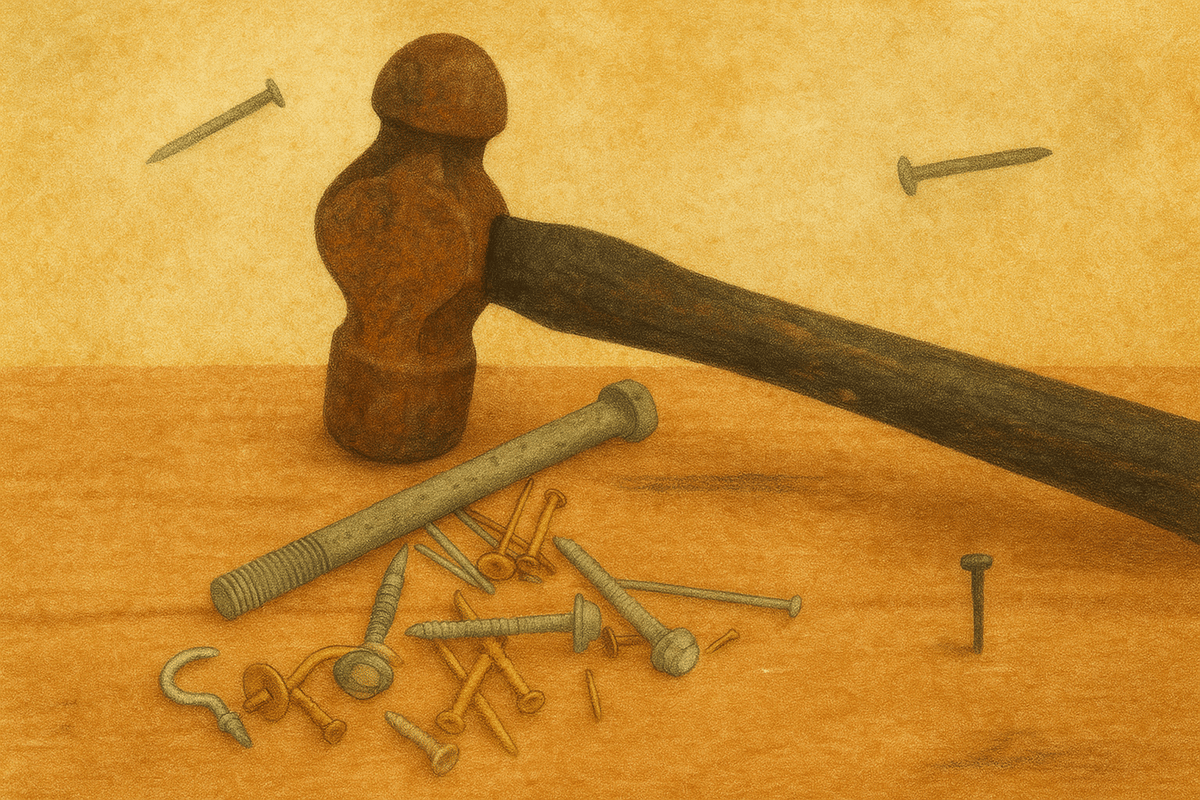
"When all you have is a hammer, everything looks like a nail." This adage perfectly captures one of the most common pitfalls we see in agile transformations. Organizations grab the most popular agile methodology, often Scrum, and apply it universally across teams, projects, and departments without considering whether it's the right fit for each unique context. This flawed approach creates unnecessary friction and often derails transformation efforts.
The Framework Fixation
We recently worked with a technology leader who proudly declared, "We're a Scrum shop. Everyone does Scrum." When asked why, he paused before admitting, "Because that's what I know best."
This agile methodology fixation isn't surprising. We naturally gravitate toward familiar tools and solutions, especially under pressure to deliver results quickly. Consultants and coaches contribute to this problem when they promote their preferred methodology as a universal solution rather than helping organizations develop contextual awareness.
But this one-size-fits-all approach creates unnecessary friction and often leads to disappointment with agile adoption overall.
A Tale of Two Companies
Consider two organizations we've worked with recently:
Company A was a fast-growing fintech startup developing a new payment platform. Their work involved significant uncertainty, frequent requirement changes, and the need for regular stakeholder feedback. The team was co-located, had end-to-end ownership of their product, and needed to move quickly in a competitive market.
Company B was an established insurance provider maintaining core systems while gradually modernizing their technology stack. Their work involved a mix of planned feature enhancements, compliance updates, and urgent production issues. Teams were distributed across multiple time zones and shared dependencies with other groups.
Both companies initially implemented Scrum across all teams. Company A thrived with the agile methodology's emphasis on regular planning, daily synchronization, and sprint reviews to gather feedback. The sprint structure provided helpful boundaries without constraining their creativity.
Company B, however, struggled. The unpredictable nature of production support made sprint planning exercises feel artificial. Teams constantly broke sprints to handle urgent issues. The distributed nature of their workforce made daily standups logistically challenging.
After analyzing their workflow, Company B shifted their maintenance teams to a Kanban approach that better accommodated variable work types and arrival rates. They maintained Scrum for their modernization initiatives where more predictable, focused work was possible.
Both companies succeeded not because they found the "best" agile methodology, but because they understood that effective implementation requires matching their approach to their specific context.
Beyond the Scrum Default
Scrum provides tremendous value in the right circumstances, particularly when:
Requirements need regular refinement and prioritization
Frequent stakeholder feedback is valuable
Teams benefit from time-bounded focus periods
Work can be reasonably planned in short increments
But other contexts call for different approaches:
Kanban often works better when:
Work arrives unpredictably (like support requests)
Flow efficiency matters more than iteration boundaries
Teams need to visualize different work types simultaneously
Rapid reprioritization is common
Hybrid approaches might be appropriate when:
Some work is predictable while other work is interrupt-driven
Teams are transitioning between methodologies
Different team members handle different types of work
The question isn't "Scrum or Kanban?" It's "What approach best serves this specific context?" And the answer might change as your organization evolves.
Clarity in Roles and Responsibilities
Framework selection is only part of the puzzle. Clear roles and responsibilities are equally important, regardless of your chosen methodology.
One healthcare technology client implemented Scrum but maintained their traditional project management structure alongside it. The result was confusion about decision authority, duplicated reporting, and frustrated team members receiving conflicting guidance from product owners and project managers.
Successful transformations require thinking through how new ways of working interact with existing organizational structures. This includes:
Who prioritizes the work?
Who removes impediments?
Who communicates with stakeholders?
Who is responsible for quality?
Who facilitates continuous improvement?
Sometimes, traditional roles can evolve into agile ones. Other times, organizations need to reimagine their structure entirely. There's no universal answer, only thoughtful consideration of your specific circumstances.
Moving Beyond Hammers and Nails
As you consider your agile transformation, we encourage you to resist the temptation to apply a single solution everywhere. Instead:
Start by understanding the nature of your work: its predictability, dependencies, and feedback requirements
Consider your organizational context: team distribution, existing structures, and cultural factors
Experiment with approaches matched to different contexts
Be willing to adapt as you learn
We'll explore how to structure teams for maximum effectiveness in different contexts in a later post. For now, remember that the strongest agile organizations aren't those with the purest implementation of any single framework, but those skilled at selecting and adapting the right tools for each unique challenge they face.