
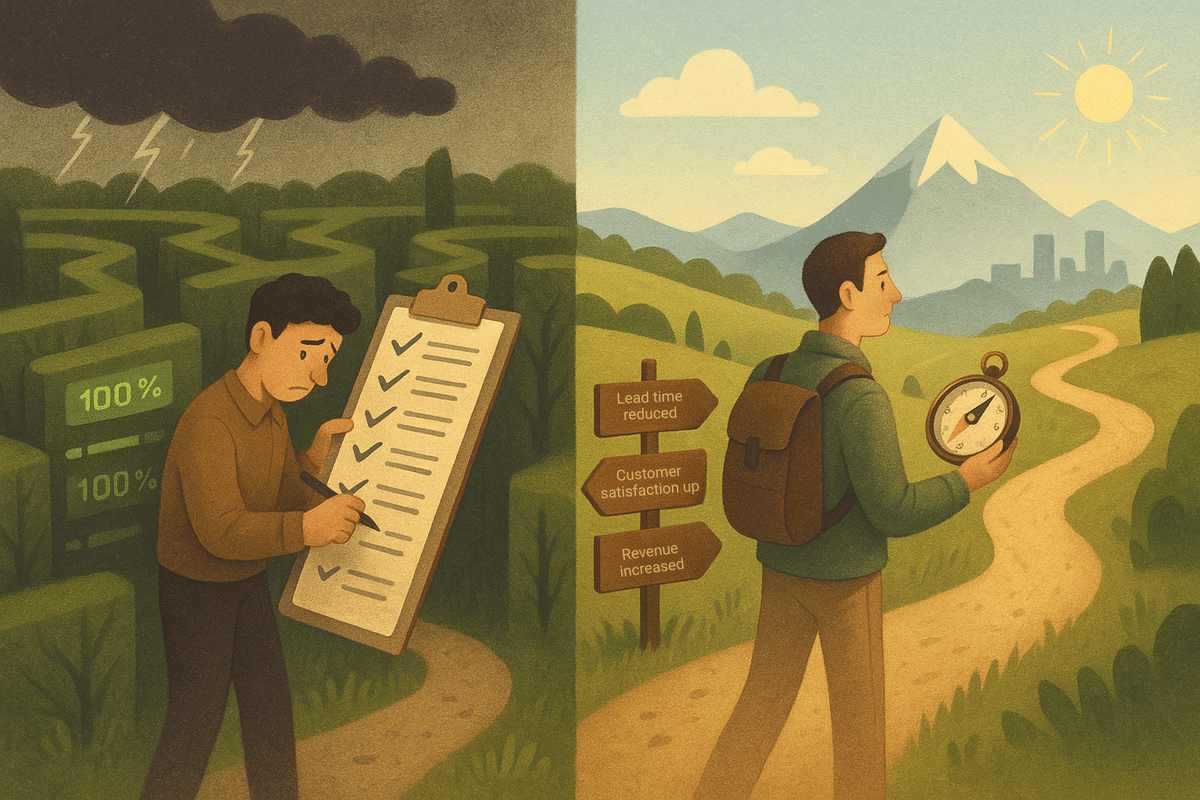
When organizations embark on agile transformations, they often approach the journey with a linear mindset: let’s define the end goal, map out the steps to achieve that end goal, and then follow the steps, implement these practices, and success will (inevitably?) follow. But after guiding dozens of companies through this process, we've learned that transformation is anything but linear. It's a complex challenge that requires a fundamentally different adaptive approach to achieve success.
Understanding Organizational Complexity
Organizations are complex systems, more like an organic system than a mechanical machine. What's the difference? A mechanical system, like a jet engine, has many parts that work together, following predictable patterns. With enough expertise and careful analysis, we can fully understand how it works. Furthermore, solutions that work on one mechanistic system can be used with confidence to solve a similar problem in another mechanistic system.
Complex systems, like organizations, markets, or ecosystems involve many interconnected agents whose behaviour can impact the outcome, making the behaviour of the entire system highly sensitive to the behaviour of individual agents in the system. As a result, the system behaves in a non-linear, unpredictable manner. Small changes can cascade into major effects. This means what works in one complex system is very unlikely to work in another complex system. People adapt their behaviors based on their context. Cause and effect become apparent only in retrospect. These systems are called complex adaptive systems.
Why Traditional Management Fails in Complex Environments
Traditional management approaches were designed for complicated mechanistic systems - linear systems in which the behaviour of the system is predictable - not complex adaptive systems in which the behaviour is unpredictable. This is reflected in the traditional approach to problem solving (or project delivery) which runs counter to the actions that are needed in a complex adaptive system:
Detailed upfront planning assumes predictability where little exists
Rigid hierarchies slow response times when quick adaptation is needed
Standardized processes eliminate the variance sometimes needed for innovation
Specialized silos create barriers to the cross-functional collaboration required to solve systemic issues
In complex environments, effectiveness (doing the right things) trumps efficiency (doing things cheaply). Yet many organizations optimize for efficiency, standardizing processes to reduce costs while inadvertently reducing their ability to adapt to a dynamic environment.
Models as Navigation Tools
If complexity makes precise prediction impossible, how do we navigate change? This is where models become valuable not as exact representations of reality, but as tools for sense-making.
Value stream mapping offers a perfect example. By visualizing how value flows through your organization to customers, you can identify bottlenecks, handoff points, and feedback loops. It allows us to view the system as a moving, shifting system. If, instead, we focus on creating a process flow chart, defining what must get done at each step, we end up with a brittle representation of the system. One manufacturing client discovered that a quality approval process designed to reduce errors was actually creating a three-week delay that cost them more in lost business than the occasional defect they prevented.
The value wasn't in perfectly documenting every step, but in creating a shared understanding that sparked productive conversations about improvement opportunities.
Learning from Spotify: Adaptability Over Conformity
The famous Spotify model with its squads, tribes, chapters, and guilds has been widely copied often with disappointing results. What many miss is that Spotify's success didn't come from their specific organizational structure, but from their approach to complexity.
Rather than mandating one way of working, they created conditions for teams to self-organize around value delivery. They established clear outcomes but allowed flexibility in how teams achieved them. They treated their organizational model as an experiment to be continuously refined, not a fixed structure.
When a healthcare technology client approached us about "implementing the Spotify model," we instead focused on the principles behind it: autonomous teams aligned toward common goals, communities of practice to share knowledge, and mechanisms for coordination without excessive control. Their resulting structure looked quite different from Spotify's but embodied the same complexity-conscious approach.
Finding Balance in Complexity
Managing in complex environments doesn't mean abandoning structure or precision. Rather, it requires balancing seemingly contradictory elements:
Enough structure to align efforts without stifling adaptation
Enough standardization to enable collaboration without preventing innovation
Enough planning to provide direction without creating false certainty
Enough measurement to provide feedback without creating perverse incentives
In our next post, we'll explore specific organizational structures that help navigate complexity while enabling agile delivery. For now, we encourage you to examine your transformation efforts through the lens of complexity: Are you trying to solve complex challenges with complicated mechanistic solutions? Are your models serving as conversation starters or rigid templates? Are you optimizing for efficiency at the expense of adaptability?
Remember, in complex environments, the goal isn't perfect prediction but resilient response to emerging conditions. Success comes not from having all the answers, but from creating organizations capable of continual learning and adaptation.